Founded 2011
Before EcoCash, There Was a Five-Year Court Battle That Nearly Bankrupted Its Founder
Strive Masiyiwa fought the Zimbabwean government all the way to the Constitutional Court just to be allowed to run a phone network.
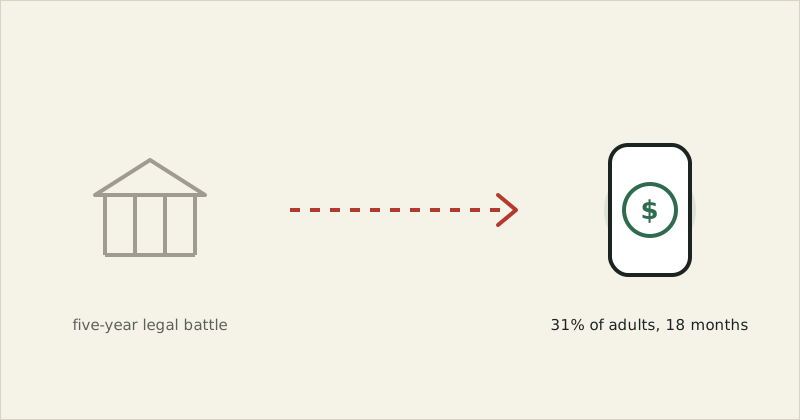
Before you could send money on EcoCash, its founder had to survive a five-year legal war against the Zimbabwean government just to be allowed to run a phone network at all.
Hold up — wait, a phone company had to go to court to be allowed to exist? Yes. Not a metaphorical fight, either — an actual constitutional court case that dragged on for five years and, by his own account, took the founder to the edge of bankruptcy.
The pitch that got rejected, then criminalized
In 1993, Strive Masiyiwa approached Zimbabwe's state-owned Posts and Telecommunications Corporation (PTC) with a proposal to launch a mobile phone network as a joint venture. PTC turned him down flat, telling him mobile telephony was a passing fad and that they held a monopoly on telecommunications anyway. When Masiyiwa asked, reasonably, whether they'd at least let him operate it himself since they weren't interested — they threatened him with prosecution if he tried.
Five years, two Supreme Court rulings, and a president's decree
Masiyiwa took it to court instead of walking away. He won at the High Court in 1994. PTC appealed, and the Supreme Court overturned that win later the same year. He came back with a different legal argument entirely — that blocking access to phones violated the constitutional right to freedom of expression — and won again at the Supreme Court in 1995.
Then Zimbabwe's president issued a moratorium blocking all private cellular licenses in 1996, wiping out the win. Masiyiwa kept going. A final Supreme Court order in 1997 finally forced the government to issue the license. Econet Wireless connected its first customer in July 1998 — five years, almost to the month, after that first rejected proposal.
Hold up — imagine winning a legal case, having the win taken away by presidential decree, and just... continuing anyway. That's not stubbornness, exactly, that's something closer to genuine conviction that you're right and everyone blocking you is wrong. It's also, by his own telling, a fight that nearly bankrupted him along the way.
From court win to mobile money
Econet grew into Zimbabwe's largest telecom operator over the next decade. In 2005, the company built a simple mobile payment tool to help NGOs transfer cash to refugees after the Burundi conflict — not built for the general public at all, just a practical fix for a specific aid problem.
That underlying technology became the foundation for EcoCash, launched in September 2011. Zimbabwe's economy was, at the time, desperately short on physical cash after years of currency turmoil, and EcoCash offered a way to move money without needing banknotes that simply weren't available. Within 18 months, 31% of Zimbabwe's entire adult population had signed up.
Worth Taking Away
- 1.The company that eventually built EcoCash almost didn't exist at all — it took a five-year constitutional court battle just to legally be allowed to operate a phone network in the first place.
- 2.Refusing to pay a bribe to make the problem go away, when that would have been the easy path, is a genuinely harder call than it sounds from the outside.
- 3.The mobile money pilot that became EcoCash grew out of a completely different use case (refugee cash transfers) years before it launched publicly — the eventual big idea rarely announces itself as the big idea right away.