Founded 1976
It Started With a $27 Loan to 42 People. It Became a Nobel Prize.
Muhammad Yunus lent strangers his own pocket money because the banks wouldn't. Decades later, that refusal built an entire industry.
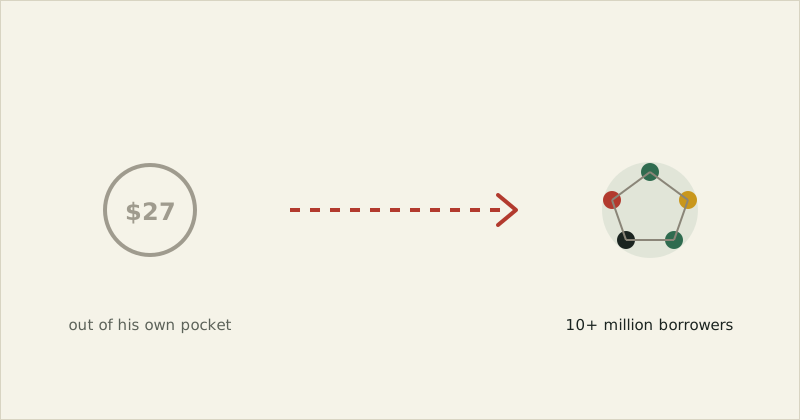
In the mid-1970s, an economics professor in Bangladesh lent forty-two people a combined twenty-seven US dollars out of his own pocket. Decades later, that same idea had a Nobel Peace Prize attached to it.
Hold up — twenty-seven dollars. Total. Split between forty-two people. That's not even a rounding error in most loan portfolios — and it's the literal starting point of an industry that now moves tens of billions of dollars a year to people banks wouldn't touch.
The problem banks refused to look at
Muhammad Yunus was teaching economics at the University of Chittagong during a devastating famine in Bangladesh. Visiting a nearby village, Jobra, he found a group of people making bamboo stools, trapped in a cycle familiar to small producers everywhere: they had to borrow from local moneylenders just to buy raw materials, at interest rates steep enough that most of their profit was gone before they'd made a single sale.
Yunus totaled up what forty-two of these borrowers collectively owed. It came to $27. Not per person — total. He paid it out of his own pocket, with no expectation of anything beyond getting people out from under predatory rates.
It got repaid. Every bit of it. So he tried the same thing at a larger scale, and approached traditional banks about funding it properly. They said no — these borrowers had no collateral, no credit history, nothing a conventional bank considered "creditworthy."
Hold up — the banks looked at the same group of people who had just paid back a hundred percent of what they borrowed, and concluded they were too risky to lend to. Sometimes the system being technically correct on paper and being obviously wrong in reality are two different things.
Building the bank himself
Yunus ran it as a formal research pilot from 1976, eventually founding Grameen Bank — Bengali for "village bank" — as its own independent institution in 1983. The model relied on small peer groups rather than collateral: borrowers, mostly women, formed groups that vouched for each other, which meant nobody wanted to be the person who let their neighbors down.
It worked at a scale nobody predicted. Grameen Bank has since lent tens of billions of dollars to more than ten million borrowers, over 95% of them women, with a repayment rate that regularly beats conventional banking. In 2006, Yunus and Grameen Bank jointly won the Nobel Peace Prize for it.
Why it matters here
The core insight — that a small loan, priced honestly instead of predatorily, can change what someone's able to build — is the same idea underneath every ordinary loan calculation. The numbers on our loan calculator are a much smaller, much more mundane version of the exact question Yunus was asking in Jobra: what does this loan actually cost the person taking it, and is that fair?
Worth Taking Away
- 1.Twenty-seven dollars, split between 42 people, is not a meaningful amount of money by any normal definition — and it still became the starting point of an entire global industry, because the idea behind it was the actual asset, not the amount.
- 2.The banks weren't wrong that these borrowers looked risky on paper. They were wrong about what that meant. A 95%+ repayment rate proved the paper was measuring the wrong thing.
- 3.Building something specifically for the people everyone else has decided aren't worth serving is not just a nice thing to do — it can be the actual business model, and a Nobel-Prize-winning one at that.