Founded 2007
M-Pesa Was Supposed to Be a Loan Repayment Tool. Users Had Other Plans.
Kenya's mobile money pilot was built for microfinance loan tracking. People just wanted to send cash to family instead.
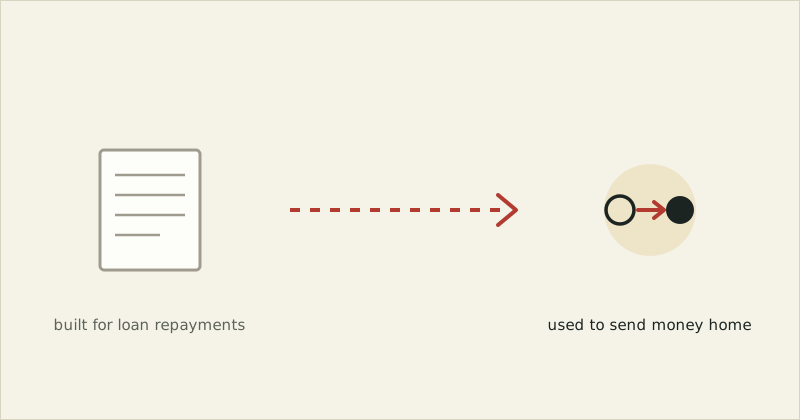
M-Pesa, the mobile money service that inspired EcoCash and a dozen others like it across Africa, wasn't originally built for what it's actually used for. It was built to help a microfinance lender track loan repayments.
Hold up — so the thing that changed how half a continent moves money was originally... a loan tracking spreadsheet with extra steps? Basically, yes. Nobody involved set out to build "send money to your cousin instantly from your phone." That part happened because users just started doing it anyway.
Built for microfinance, funded as an experiment
In the early 2000s, the UK's Department for International Development set up a fund to back private-sector projects that could improve access to financial services in developing countries. Vodafone won a grant to build a mobile money product, working with its Kenyan affiliate Safaricom and a local microfinance lender called Faulu. The idea was specific: let Faulu's loan officers disburse and collect small loan repayments over mobile phones instead of handling cash in person.
The pilot launched with a small group of real users in 2005 and 2006. And that's where the plan quietly derailed, in the best possible way.
The users had other ideas
People in the pilot weren't just using the tool to manage loan repayments. They were using it to send money to family members in other parts of the country — something the product was never specifically designed to do, but which the underlying technology handled just fine. Faulu also ran into technical problems keeping a stable connection for the loan-tracking side specifically, which pushed the picture even further away from the original plan.
Safaricom made the call to launch commercially in March 2007 focused on general money transfer — marketed plainly as "Send Money Home" — and dropped the microfinance-specific framing that started the whole project.
Hold up — this is basically the same move Instagram made when it noticed everyone ignoring the check-in feature and just posting photos instead — except this time the "feature nobody expected to matter" was a way for millions of unbanked people to access financial services for the first time. Different continent, different problem, same underlying lesson: watch what people actually do with the thing.
What it actually became
Uptake was immediate and enormous — over 20,000 customers in the first month alone, well past what anyone had projected. M-Pesa now operates in multiple countries across Africa, and its core idea — that you don't need a bank account, just a phone number, to move money — became the direct template EcoCash and dozens of other mobile money services across the continent were built on a few years later.
Worth Taking Away
- 1.The pilot users didn't do what the product was designed for — they used it to send money to family instead of tracking microloans — and the team building it was smart enough to notice and follow that instead of fighting it.
- 2.A six-month pilot with real users told them more than any amount of planning could have. Small-scale reality beats a big theoretical roadmap.
- 3.M-Pesa's entire premise — that most people didn't have or need a bank account to move money — was treated as an obstacle by traditional banks and as the actual opportunity by everyone who built this instead.