Founded 1991
The Guy Who Got Sick of Documents Looking Different on Every Computer
A 1991 memo called "Camelot" is the reason a PDF looks the same whether you open it in Harare or Tokyo.
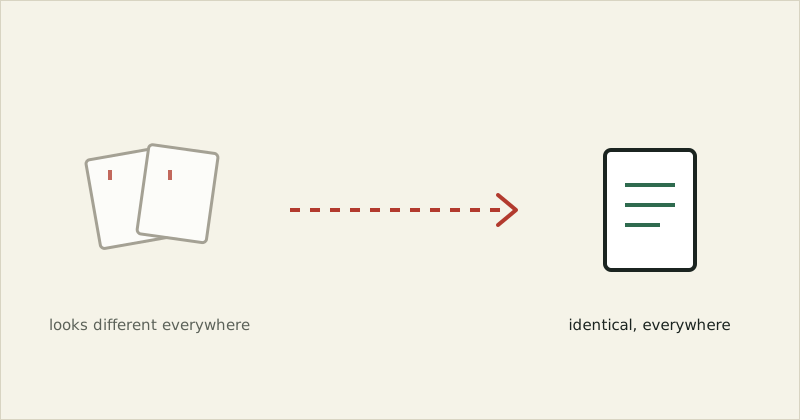
Every time you merge a PDF on this site, you're using a file format that exists because one Adobe executive got fed up with a genuinely mundane problem: documents looked different depending on whose computer opened them.
Hold up — that's it? That's the whole spark? Yes. No dramatic garage, no rejection letter, no lawsuit. Just a guy who was tired of fonts breaking when a file moved from one machine to another. Sometimes the biggest ideas really are just "this small annoying thing should stop happening."
The chaos before PDF existed
In 1990, sharing a document between two computers was a genuine mess. A file made in WordPerfect on a DOS machine looked wrong when opened in Word on a Mac. Fonts swapped themselves out. Layouts shifted. Printing required having the exact same software and fonts as whoever made the file. Faxing degraded everything further. What you saw was reliably not what anyone else got.
John Warnock, Adobe's co-founder, had been sitting with this problem for years. Adobe had already changed printing forever with PostScript, a language that told printers exactly how to render a page — but PostScript only worked for printing, not for viewing something on screen.
The two-page memo that started it
In 1991, Warnock wrote an internal memo under the codename "Camelot." The pitch was simple: what if any document, made in any application, on any computer, could be captured and displayed or printed anywhere else with perfect fidelity? He described it almost poetically for a technical memo — imagine sending full text-and-graphics documents over email, viewable on any machine, printable on any printer.
In 1991, before the web was mainstream and email was mostly plain text, that was a genuinely strange thing to imagine wanting.
The decision that actually made it spread
Adobe Acrobat 1.0 shipped in June 1993, two years after that memo. It had four pieces: a paid tool to create and edit PDFs, a free viewer to read them, a converter, and an indexing tool. That "free viewer" decision was not an accident — it was the entire strategy. A document format only works if the person receiving it can actually open it without paying anything. By giving away the reader and charging for the creation tools, Adobe seeded PDF everywhere at once.
Hold up — give away the thing people need to open it, charge for the thing people need to make it — that's such an obvious move in hindsight that it's easy to forget somebody had to actually decide to do it, on purpose, in 1993, before "freemium" was even a word anyone used.
Where it ended up
PDF became so foundational that Adobe eventually handed control of it over entirely — it was standardized as an open ISO standard in 2008, meaning no single company owns it anymore. It's the format governments use for official documents, the format publishers use for print-ready files, and, on a much smaller scale, the format you're probably about to merge two files into on this exact page.
Worth Taking Away
- 1.The most boring-sounding problem ("documents look different on different computers") turned out to be worth building an entire company's future around.
- 2.Giving away the reader for free while charging for the tool to create files was the actual masterstroke — nobody adopts a format they can't open without paying first.
- 3.A format doesn't need to be exciting to become essential. It just needs to solve the one thing everyone was quietly annoyed about.