Founded 1994
QR Codes Were Invented on a Lunch Break, Playing a Board Game
An engineer trying to speed up a Toyota factory line had his eureka moment over a game of Go — then gave the invention away for free.
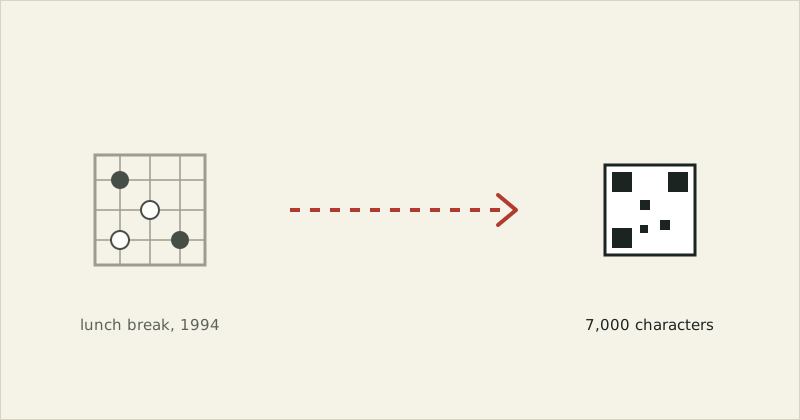
The little black-and-white square you scan for a menu, a WiFi password, or an EcoCash payment was invented by a Japanese engineer on his lunch break, staring at a board game.
Hold up — a board game? What does Go have to do with a barcode? Genuinely nothing, until one guy noticed the black-and-white stones on a 19-by-19 grid could represent information the same way a barcode's stripes do — just in two dimensions instead of one. Sometimes the connection between two completely unrelated things is the whole invention.
The actual problem: too many barcodes on one car part
In the early 1990s, Masahiro Hara worked at Denso Wave, a parts supplier under the Toyota Group. Toyota's factories ran on a "just-in-time" system that depended on scanning barcodes constantly to track parts moving through production. The trouble was that a standard barcode could only hold about 20 characters — so a single part sometimes needed up to ten separate barcodes stuck on it just to carry all the necessary information. Workers were scanning thousands of these a day. It was slow, and it was wearing everyone out.
The lunch-break idea
Hara used to play Go on his breaks — the ancient strategy game played with black and white stones on a grid. According to his own account, arranging the stones one day, it hit him: the pattern of stones was a straightforward way of representing information. If a barcode's stripes could only encode data in one direction, a grid could encode it in two.
He and a two-person team spent two years working out the technical details — how to make a scanner recognize the code instantly regardless of rotation or size, and how to keep it readable even if part of it got damaged or dirty on a factory floor. In 1994, the QR code — "QR" for Quick Response — was introduced, able to hold roughly 7,000 characters. Compare that to the 20 characters a barcode struggled with.
Hold up — 20 characters to 7,000 characters is not an upgrade, that's a completely different category of thing. That's the difference between a barcode and basically a tiny web page. No wonder it eventually escaped the factory floor entirely.
The decision that made it everywhere, not just Toyota
Here's the part that actually explains why you're scanning QR codes today instead of some competing format nobody adopted: Denso Wave held the patent, and chose not to enforce it. Anyone could use QR codes for free, no licensing fee, no permission needed. Hara has joked in interviews that he doesn't get a commission every time one is scanned — and said, only half-joking, that he wishes he did.
That single decision not to lock the format down is arguably the entire reason it spread everywhere: restaurant menus, WiFi passwords, mobile payments, vaccination records during COVID, and the QR generator sitting two clicks away from this article. Hara, remarkably, still works at Denso decades later, still developing what comes next.
Worth Taking Away
- 1.Solutions to boring industrial problems (scanning too many barcodes on a car part) can turn into something used by literally everyone, for completely different reasons than intended.
- 2.Deliberately not enforcing the patent is arguably the single biggest reason QR codes became the global default instead of a forgotten Japanese factory tool.
- 3.Inspiration can come from anywhere, including a board game on your lunch break. The trick isn't waiting for it — it's actually being the kind of person still turning the problem over when it shows up.